


NEWS
Categories List
Which Sinotruck Dump Truck Configurations Fit Short-Haul Earthmoving Jobs
Choosing the right Sinotruck dump truck for short-haul earthmoving can directly affect jobsite efficiency, fuel costs, and delivery schedules. For project managers and construction leaders, the question is usually not “which truck has the biggest payload,” but “which configuration keeps the cycle time stable without creating avoidable maintenance, access, or safety problems.” In short-haul work, where trucks move material repeatedly over limited distances, configuration decisions often matter more than headline specifications.
Short-haul earthmoving typically means frequent loading, short internal transport routes, uneven ground, tight turning zones, and high daily trip counts. Under these conditions, the best truck is often the one that matches site geometry and material type, not the one with the highest nominal capacity.
Why configuration matters more on short cycles
On road construction, foundation excavation, industrial park grading, or quarry-to-crusher shuttle work, trucks lose time less on speed and more on maneuvering, queueing, loading compatibility, and dumping stability. That changes the selection logic.
A truck that is oversized for the haul route may carry more per trip, but it can also turn slower, consume more fuel at idle and in stop-start operation, and increase tire and suspension wear on rough internal roads. A truck that is too small may move well, but force the site to add units and drivers to hit the same output target. For project managers, the practical goal is balancing payload, turning radius, traction, body volume, and serviceability.
For most short-haul earthmoving, 6x4 is the working baseline
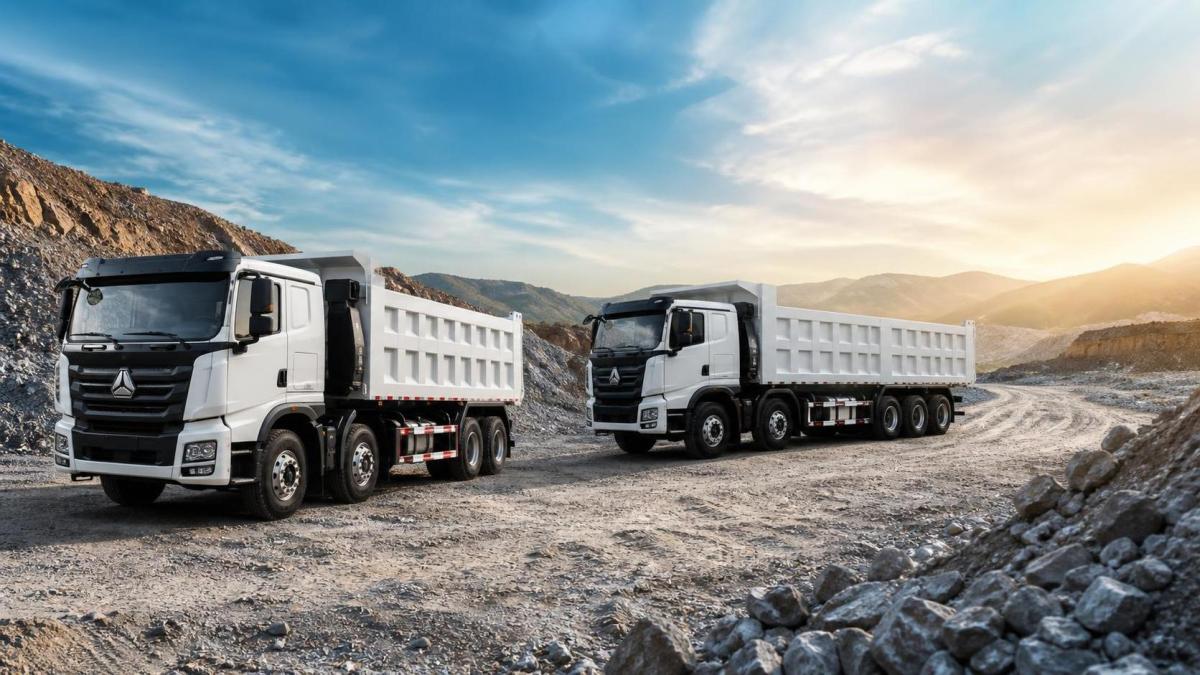
In many engineering vehicle applications, a 6x4 Sinotruck dump truck is the most balanced starting point. It usually fits projects where haul roads are temporary but not extreme, travel distance is short, and material includes soil, sand, gravel, or mixed excavation spoil.
The strength of the 6x4 setup is not just payload. It is the compromise between capacity and maneuverability. For urban excavation support, plant construction, and medium-scale site development, 6x4 trucks tend to work well because they can maintain acceptable load volume without becoming too cumbersome in confined work zones.
This configuration is often suitable when:
- haul roads are compacted but imperfect;
- loading is done by 20–30 ton excavators or similar equipment;
- site access includes ramps, temporary turns, or stockpile edges;
- daily cycles are high enough that fuel and tire wear must be controlled.
For many contractors, this is the safest operational choice when job conditions are mixed and the route may deteriorate during rain or heavy use.
When 8x4 makes sense—and when it does not
An 8x4 Sinotruck dump truck becomes attractive when volume per trip matters more than maneuverability. On large earthworks with wider haul roads, stable loading areas, and enough turning space, 8x4 can reduce the number of trips and lower unit transport cost per cubic meter or per ton.
That said, project teams often overestimate the benefit of 8x4 on compact sites. If the loading point is congested, if dump positions are narrow, or if internal roads are soft, a larger truck may create delays that offset the payload advantage. In soft ground conditions, higher gross weight can also worsen rutting and road maintenance needs.
8x4 is generally more suitable when:
- the project has broad internal roads and organized traffic flow;
- material is dense and output targets are high;
- the site can support the truck’s weight consistently;
- the loading and dumping points are not space-constrained.
For short-haul work, 8x4 is a productivity tool only if the site is already structured to use it efficiently.
For soft ground, steep grades, or unstable haul roads, look harder at traction
Not all short-haul routes are simple. Dam embankment work, mining support roads, wet clay sites, and undeveloped earth platforms can shift the decision away from pure payload. In these cases, a configuration with stronger traction may protect actual output better than a higher-capacity model that gets stuck, spins tires, or requires road rework.
This is where teams should pay attention to axle drive layout, differential options, ground clearance, and tire matching—not only engine power. A truck that keeps moving reliably in poor underfoot conditions often delivers better daily production than a nominally larger unit operating at partial efficiency.
Project managers should also assess whether a standard road-biased dump body and chassis setup is sufficient, or whether the job requires more robust suspension and body reinforcement for rock, broken material, or repeated off-road shock loads.
Body type should match material, not just truck size
A common mistake in dump truck selection is focusing on chassis configuration while overlooking body design. Short-haul earthmoving may involve topsoil, wet clay, blasted rock, demolition spoil, or mixed fill. Each behaves differently during loading and tipping.
For sticky material, body shape and tipping efficiency matter because hang-up increases cycle time and cleanup labor. For abrasive or heavy rock, wear resistance and floor thickness become more important than nominal volume. If the truck body is oversized for material density, legal road limits may be irrelevant on internal roads, but chassis stress and premature wear are still real operational issues.
In practice, the right body specification can improve output almost as much as the right axle layout.
What project leaders should check before confirming a fleet mix
Before choosing a Sinotruck configuration, project leaders should map the job using operating facts rather than brochure categories:
- average one-way haul distance;
- road width and turning constraints;
- ground bearing conditions in dry and wet weather;
- material density and moisture variation;
- loader or excavator bucket size;
- required daily movement volume;
- onsite maintenance capability and parts access.
That last point is often underestimated. In short-cycle jobs, downtime is highly visible. A technically suitable truck with weak parts support can become a scheduling problem very quickly. For export buyers and contractors working across regions, support for service items, hydraulic components, tires, and axle parts should be evaluated alongside truck specification.
The practical selection logic
For most short-haul earthmoving jobs, 6x4 remains the most practical all-round Sinotruck configuration because it balances payload, maneuverability, and route tolerance. 8x4 fits high-volume sites with better roads and more space, where reducing trips outweighs access constraints. On poor ground or severe gradients, traction and durability should take priority over body capacity.
The best decision is rarely about buying the “largest” truck. It is about matching truck configuration to cycle conditions, material behavior, and the real bottleneck on site. For project managers, that is what turns a dump truck from a transport asset into a reliable production tool.
Leave A Reply